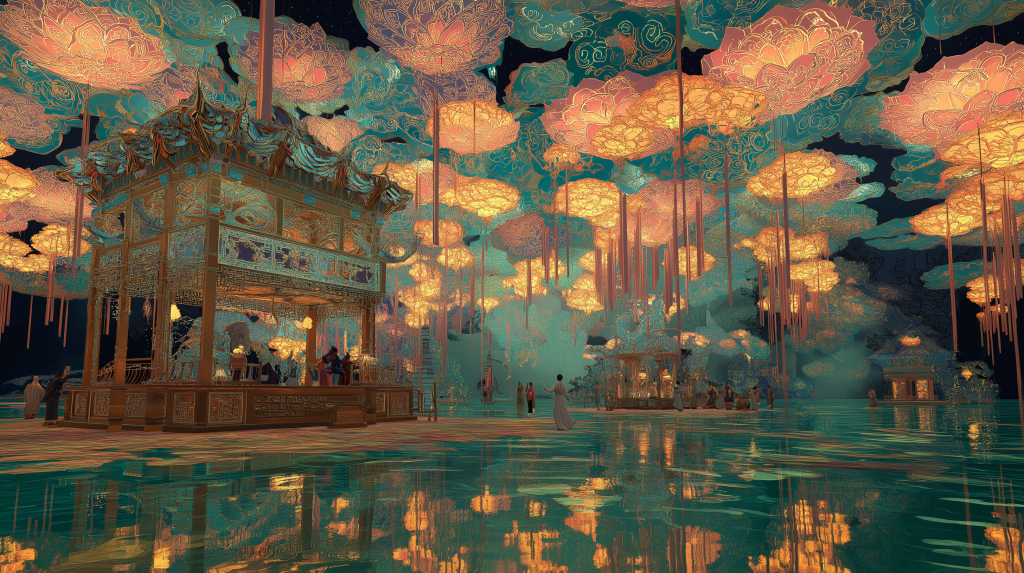
When we think of festivals, we often think of celebration—colorful parades, family gatherings, seasonal foods, and moments of collective joy. But beneath the surface of these festive scenes lies something more enduring: a coded structure of time, ritual, and symbolism through which a culture expresses its worldview. Festivals are not simply events that happen in time—they are events that shape how we understand time.
In this issue of Culture Decode, we explore how traditional festivals can be read as cultural structures. Through their timing, rituals, symbolic objects, and embedded metaphors, festivals reveal how a society makes meaning, remembers the past, and imagines itself.
Festivals Are More Than Celebrations
At first glance, a festival seems like a periodic event—a pause from routine, a time to gather and mark something meaningful. But in many cultures, festivals are not exceptions to the everyday; they are frameworks that organize the everyday.
Festivals serve multiple functions:
- Temporal: They mark the passage of time in culturally significant ways.
- Ritualistic: They create shared scripts of behavior, often repeated across generations.
- Symbolic: They use material forms—objects, foods, costumes—to communicate values.
- Mnemonic: They act as vessels of cultural memory, preserving identity through repetition.
Seen this way, a festival is less like a party, and more like a cultural operating system.
The Four-Layer Model: How to Decode a Festival
To understand how a festival encodes meaning, we can break it down into four symbolic layers:
1. Time Point
When a festival occurs is never random. It usually aligns with seasonal changes, historical anniversaries, or cosmic markers. For example, the Chinese Qingming Festival occurs in early April, when spring begins to transform the landscape—perfect timing for a ritual of remembrance and renewal.
2. Ritual Act
Rituals are structured performances. They may include offering food to ancestors, lighting candles, fasting, dancing, or simply gathering together. Ritual actions not only express values—they embody them.
3. Symbolic Object
Most festivals involve symbolic items: mooncakes, lanterns, wreaths, turkeys, candles. These objects are not chosen for convenience but carry metaphorical weight.
4. Cultural Metaphor
At the deepest level, a festival encodes a metaphor. Thanksgiving is not just about food—it’s a metaphor for survival, gratitude, and national origin myth. The Mid-Autumn Festival is not just about mooncakes—it’s about longing, reunion, and cyclical time.
By reading these four layers together, we begin to see a festival not just as a social gathering, but as a symbolic text.
Time: Linear or Circular?
Different cultures imagine time differently, and festivals are one of the clearest expressions of this.
In many Western traditions, time is viewed as linear: progressing from past to future, with festivals marking turning points or commemorations (e.g. Easter, Christmas, Independence Day). These events often point to a singular origin or narrative.
In East Asian traditions, time is often seen as circular or seasonal. The 24 solar terms of the Chinese calendar, for instance, divide the year into micro-seasons, and festivals are aligned with natural rhythms. The lunar new year, Qingming, and Mid-Autumn are all located within this circular, ecological perception of time.
These structures shape how people relate to life, death, renewal, and memory. Circular time emphasizes return and regeneration; linear time emphasizes progress and causality.
Why Festival Structures Still Matter Today
In a globalized, digitized world, traditional festivals may seem distant or decorative—rituals for the nostalgic. But they still shape our cultural imagination in powerful ways.
Even when festivals are reinterpreted in modern forms—Instagram-ready “Lunar New Year” dinners, virtual Diwali celebrations, TikTok dances on Carnival—they continue to carry deep symbolic functions:
- They anchor us in collective time, offering moments of synchrony in an asynchronous world.
- They rehearse shared values, even when meanings evolve.
- They offer structure, in a time when meaning often feels scattered.
At Mindtrace, we treat festivals not as artifacts of the past, but as symbolic blueprints. By learning to read their layers—time, ritual, object, metaphor—we gain tools for interpreting cultural memory, structuring thought, and strengthening our expressive clarity.
A Final Reflection
The next time you participate in a holiday, pause to ask:
- What time of year is this? Why this moment?
- What rituals do we repeat, and how do they shape behavior?
- What objects are central, and what do they symbolize?
- What deeper metaphors are being enacted?
When we stop treating festivals as background noise and start reading them as structured texts, we don’t just learn about tradition—we gain a method for decoding culture itself.
In an age of infinite information, such symbolic thinking isn’t nostalgic—it’s strategic.
 Mindtrace
Leave a comment