Don’t jump to solutions. Break it down first.
Part of the Mindtrace Mind Lab Series
Based on “Creative Strategy: A Guide for Innovation” by William Duggan
“The first phase of creative strategy is called rapid appraisal.
It identifies what problem your innovation needs to solve and breaks the problem down into elements.”
— William Duggan
🎯 Why it matters
Every idea starts with a problem. But if your problem is too vague, your solution will be too weak.
That’s why Step 1 of Creative Strategy is about stating the problem and breaking it into key elements—before you do any brainstorming or research.
Great ideas begin with good decomposition.
This isn’t about asking “what’s wrong.” It’s about understanding the inner structure of what you’re trying to build.
📦 Case Study: Netflix Before Streaming
Let’s look at the original problem behind Netflix—not Netflix today, but the version in the late 1990s:
How can we build an online DVD rental club?
That sounds like one question. But it’s actually several interconnected decisions.
Here’s how it breaks down into a problem element matrix:
📊 Netflix Insight Matrix
| Source A Blockbuster | Source B Gym club | Source C Amazon | Source D DVDs | Source E Other | |
|---|---|---|---|---|---|
| Element 1: Business type | ✅ | ✅ | |||
| Element 2: Pay system | ✅ | ✅ | |||
| Element 3: Distribution | ✅ | ✅ | |||
| Element 4: Others? |
Instead of starting from scratch, the Netflix team identified what needed to be solved, then scanned other industries for working parts.
That’s what you’ll learn to do in Step 2—but first, let’s structure your problem.
🧠 Step-by-Step Exercise: State and Structure Your Problem
Choose a challenge you’re facing right now. It can be:
- A project idea
- A research topic
- A business concept
- A creative concept
- A thesis, pitch, or proposal
1️⃣ Write your core innovation question
Example: How can I create a digital storytelling platform for traditional art archives?
2️⃣ Break it down into Problem Elements
Ask:
- What components does this challenge include?
- What tradeoffs or decisions are involved?
- What parts must be built, designed, or sourced?
Example Breakdown:
| Problem Element | Description |
|---|---|
| Content Type | Is it image-based, audio, video, or text-based? |
| User Interaction Model | Is it passive viewing or interactive storytelling? |
| Technology Infrastructure | Is this a website, mobile app, or physical exhibit? |
| Community / Access Model | Who is it for? Open-access or curated community? |
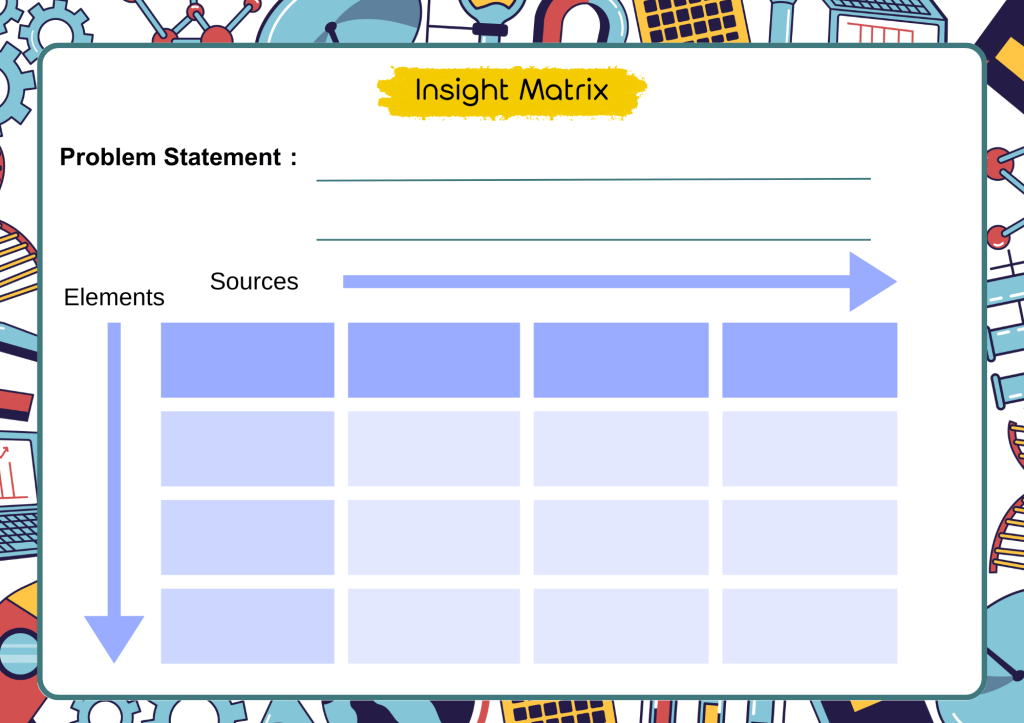
These elements will become the rows of your Insight Matrix in Step 2.
🔍 Bonus: Build Your Own Insight Matrix (Optional Preview)
Your Matrix will look like this:
| Source A (Proven Case) | Source B (Cross-Industry Idea) | Source C (Failure / Caution) | |
|---|---|---|---|
| Element 1: Content Type | ✅ (Online archive) | ✅ (Oral history games) | ❌ (Unmoderated uploads) |
| Element 2: UX Model | ✅ (Museum apps) | ✅ (Gamified learning) | ❌ (Confusing navigation) |
| Element 3: Tech Platform | ✅ (WordPress plugin) | ✅ (AR mobile app) | ❌ (Outdated flash site) |
| Element 4: Access Model | ✅ (Open access) | ✅ (Membership-based) | ❌ (Over-monetized) |
- Columns = knowledge sources
- Source A: What worked before (success case)
- Source B: What’s working elsewhere (analogies)
- Source C: What failed and why (anti-examples)
- Rows = your structural elements
- These are the building blocks of your challenge
This matrix helps your brain see innovation as recombination, not guessing.
 Mindtrace
Leave a comment